In modern software development, building scalable and flexible systems is more important than ever. Businesses rely on distributed applications that must handle large amounts of data, users, and real-time interactions. Traditional monolithic architectures often struggle to meet these demands.
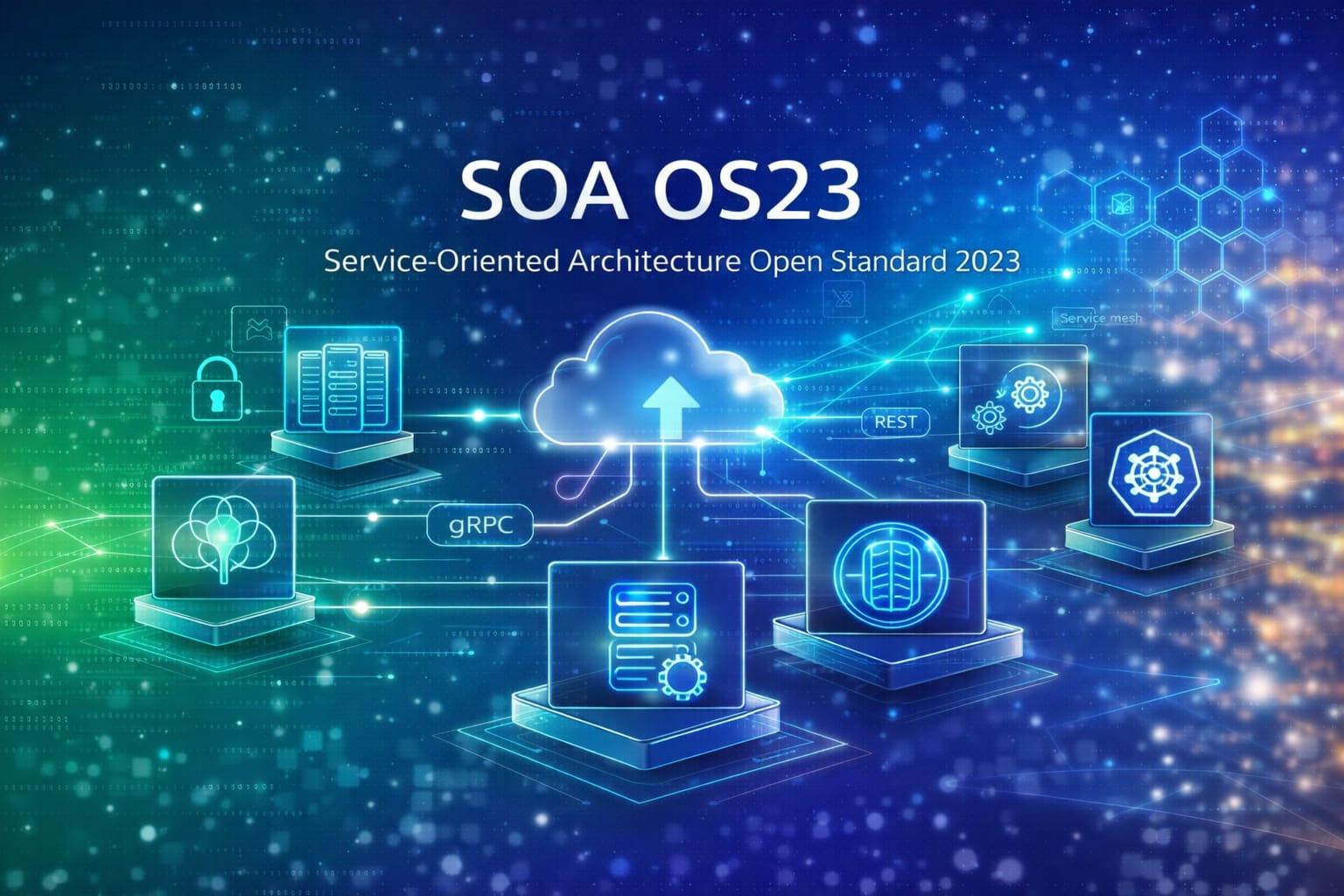
To address these challenges, modern architectural models have evolved. One of these is SOA OS23 (Service-Oriented Architecture Open Standard 2023), a framework designed to organize software into modular, reusable services that can scale efficiently in cloud environments.
SOA OS23 represents the next generation of service-oriented architecture, focusing on cloud-native design, microservices compatibility, and improved communication between services.
What is SOA OS23?
SOA OS23 is a modern service-oriented architecture framework that structures software systems into independent services.
Each service performs a specific function and communicates with other services using lightweight protocols. This design allows systems to be more flexible, scalable, and easier to maintain.
Unlike traditional monolithic systems where all components are tightly connected, SOA OS23 separates functionality into modular units. These services can be developed, deployed, and updated independently.
This architecture is particularly useful for large-scale distributed systems, cloud platforms, and enterprise applications.
The Evolution of Service-Oriented Architecture
Service-Oriented Architecture (SOA) has existed for many years. Earlier versions of SOA focused on connecting enterprise systems using middleware technologies such as Enterprise Service Buses (ESB).
However, traditional SOA frameworks often became complex and difficult to scale.
Modern technologies like containers, microservices, and cloud computing have transformed how distributed systems are designed.
SOA OS23 represents a new approach that modernizes traditional SOA concepts by integrating them with cloud-native technologies.
Key Features of SOA OS23
SOA OS23 introduces several features designed for modern software systems.
Cloud-Native Architecture
The framework is designed specifically for cloud environments. It supports technologies such as:
- Containers
- Kubernetes orchestration
- Serverless deployments
This allows applications to scale dynamically based on demand.
Modular Service Design
Applications built with SOA OS23 consist of independent services. Each service handles a specific function within the system.
This modular approach provides several benefits:
- Easier maintenance
- Faster updates
- Better system flexibility
Developers can update or replace a single service without affecting the entire application.
Lightweight Communication Protocols
SOA OS23 encourages the use of modern communication protocols, including:
- REST APIs
- GraphQL
- gRPC
These protocols enable efficient communication between services and reduce system complexity.
Service Mesh Integration
A service mesh manages communication between services in a distributed system.
SOA OS23 integrates well with service mesh technologies, allowing for:
- traffic control
- service discovery
- secure communication
This improves system reliability and performance.
Enhanced Security and AI Integration
Security is a critical part of modern software architecture.
SOA OS23 supports advanced security mechanisms such as:
- authentication services
- encrypted communication
- API security policies
In addition, the framework can integrate AI-powered monitoring tools that help detect anomalies and improve system performance.
Benefits of SOA OS23
Organizations adopting SOA OS23 can experience several advantages.
Scalability
Services can scale independently, allowing systems to handle increasing workloads without affecting overall performance.
Flexibility
Developers can build, modify, or replace services without redesigning the entire system.
Faster Development
Teams can work on different services simultaneously, accelerating development cycles.
Improved Reliability
If one service fails, other services can continue operating, improving overall system stability.
SOA OS23 vs Traditional SOA
Although SOA OS23 builds upon traditional SOA principles, there are several key differences.
Traditional SOA systems relied heavily on centralized components such as enterprise service buses. These systems often required complex configurations and large infrastructure.
SOA OS23 adopts a decentralized and cloud-native approach. It focuses on lightweight services, modern APIs, and container-based deployments.
This makes it more suitable for modern distributed systems and microservices-based architectures.
Use Cases of SOA OS23
SOA OS23 can be applied across many industries and applications.
Enterprise Applications
Large organizations often require scalable systems that integrate multiple services and departments.
Cloud Platforms
Cloud-based applications benefit from the modular design and scalability provided by SOA OS23.
E-Commerce Systems
Online stores need flexible architectures to handle transactions, inventory management, and customer services.
Financial Technology
Fintech platforms use service-based architectures to manage payments, security, and user accounts.
Challenges of Implementing SOA OS23
While SOA OS23 offers many advantages, it also introduces certain challenges.
Increased Complexity
Managing multiple services requires strong monitoring and orchestration tools.
Infrastructure Requirements
Cloud-native architectures often require container platforms and advanced deployment systems.
Security Management
With multiple services communicating across networks, maintaining secure connections is essential.
Organizations must implement strong security policies and monitoring systems.
The Future of Service-Oriented Architecture
Software architecture continues to evolve as technology advances.
Future service-oriented systems will likely integrate:
- Artificial intelligence for automated monitoring
- advanced service orchestration tools
- improved cloud infrastructure
Frameworks like SOA OS23 represent the direction modern software development is heading.
As organizations move toward distributed and cloud-based systems, modular architectures will play an increasingly important role.
Conclusion
SOA OS23 is a modern evolution of service-oriented architecture designed for cloud-native environments and distributed systems.
By organizing applications into modular services, it enables scalability, flexibility, and improved system reliability.
As technology continues to advance, frameworks like SOA OS23 will become increasingly important for building large-scale, resilient software systems.
FAQs
What is SOA OS23?
SOA OS23 is a modern service-oriented architecture framework that organizes software systems into modular, reusable services.
How does SOA OS23 differ from traditional SOA?
It uses cloud-native technologies, lightweight APIs, and decentralized service structures instead of centralized enterprise service buses.
What technologies work with SOA OS23?
Technologies such as containers, Kubernetes, REST APIs, GraphQL, and gRPC are commonly used with SOA OS23.
Why is SOA OS23 important for modern systems?
It enables scalable, flexible, and reliable distributed applications suitable for cloud environments.
Which industries use SOA architectures?
Industries such as finance, e-commerce, healthcare, and enterprise software commonly use service-oriented architectures.